
Criteria
The BASTA system is made up of different criteria areas, there are mandatory and optional criteria areas.
This page shows the system's criteria areas and an overview of the criteria's.
Criteria document
All criteria's are presented in their entirety in the BASTA system's criteria document which can be downloaded from the document page.
ATTENTION! Generation V36 is open to use already now but enters into force on the 15th of January 2026.
Organisation

This criteria area describes how companies connected to the BASTA system should work with the registration of articles in the BASTA system, and what skills are required for this.
Persons within the company or contracted consultants, who carry out assessments of products, handle documentation and/or are responsible for registration in the BASTA system must have competence according to the list below:
- Adequate knowledge of the substance content of the products in question
- Adequate knowledge of the BASTA system's criteria
- Adequate knowledge of the criteria areas in which information is provided
For assessments within the criterion area Health and environmental hazards, the following must also be met:
- Adequate knowledge of health and environmental assessment of chemical substances and products
- Adequate knowledge of REACH, the European regulatory system for chemicals control
- Adequate knowledge of classification and labelling of chemical substances according to CLP
The competence must be documented in a responsibility list together with name, title and contact information. In the event of an audit, competence must be proven by presenting a transcript of education, CV or similar.
Assessments of criteria fulfilment and supporting documents shall be documented in a summary. The compilation, assessment and supporting documents shall be archived and available as long as the company is connected to the BASTA system. Specific requirements for the compilation, assessment and supporting documents are described under each criteria area.
The summary of criteria fulfilment shall be prepared in accordance with the template specified by the BASTA system (Document/Supporting document published at www.bastaonline.se/dokument) or equivalent.
The Company shall update its assessment and registration of products if any of the following occurs:
- The composition of the product changes
- The product characteristics change
- Constituent substances are reclassified
- The BASTA system's criteria are update
If an assessment has been made against the criteria for “Health- and Environmental Hazard”, the company must also monitor whether the constituent substances have their classification changed and whether this affects the criteria fulfillment.
BASTA has the right to update the BASTA system's criteria continuously. Changes that entail stricter criteria must be notified in writing at least six (6) months before they become mandatory. Companies that have joined the BASTA system are obliged to keep up to date on new criteria and to update assessments and registrations within six (6) months of updated criteria being announced.
Companies that join the BASTA system and register products must allow audits according to the BASTA system.
During an audit, assessment and assessment documentation for a selection of registered products, responsibility list and competence as well as procedures for BASTA registrations are checked. Documentation from sub suppliers used in assessment is also covered in an audit.
Companies connected to the BASTA system have the right to show that they are connected to the BASTA system, refer to the products they have registered and tell whether a product meets one of the BASTA system's rating levels or product groups (ELECTRONICS).
Examples of where marketing can occur:
- Product documentation and catalogues
- Direct connection to the product (e.g. on shelf edges or in the webshop)
- Annual Report of the company
- In other types of media such as newspaper ads, newsletters or social media.
Affiliated companies have the right to use BASTA's trademarks; for the BASTA system, the grade levels and product groups, in accordance with BASTA's graphic profile.
If the company is marketed as affiliated to the BASTA system, one of the following must be met:
- BASTA system's logo and a link to the company page at BASTA
- Sticker with QR code to company page at BASTA
- In text is written:
“The company is connected to the BASTA system and has registered products, see BASTAonline.se for current registration status.”
If products are marketed as registered in the BASTA system, one of the following must be met:
- BASTA system logo and link to article page
- BASTA system logo and QR-code for the article page
- In text is written:
"Product name" is registered in the BASTA system, see BASTAonline.se for the current registration status. - Grade logos must be used instead of the BASTA system's logo if an assessment has been made against the criteria for Health and Environmental Hazard.
If the trademarks are misused, the following actions will be taken:
- Correction of usage will be required within a given timeframe. The length of the time frame will be assessed and set depending on the type of misuse and extent. If corrections have not been made, the company's products will be unpublished.
Article identifier

This criteria area handles article identifiers. Identifiers are used to associate information with a specific article. In order to register an article and get it published, information regarding the mandatory criteria below needs to be registered. It is also possible to register optional identifiers, this allows for better dissemination of registered articles by more efficient linking of the information to other databases.
Name of the article. If the article is available in different sizes or dimensions, they are distinguished by specifying different article description and article number
Article number of the article. If the same article is available in different designs (size, color, etc.) with different article numbers, each article must be registered separately. Avoid collection numbers or serial names, if possible, as these make it difficult for users to find articles.
Used to classify and facilitate search. For BK04, select the appropriate commodity group for the article or commodity. BK04 is divided into three levels (Main group, Subgroup and Commodity group) and it is the commodity group level that must be registered. This is indicated by 5 digits in the system. If there is no exact match of item group for an item, the one that is closest to the item's use is selected.
Used to classify and facilitate search. For BSAB, the person who registers chooses how far down in the structure they want to register. For BSAB, there is also a quick reference guide published on BASTA's website under "Documents". When the registration is done, it is recommended to enter the description in the search field instead of the code, this is as BSAB consists of a large number of lines and codes, which means that the search match otherwise risks being very wide. The function has been updated and each product group is selected by filling in the code or part of the product group description. All available options will be displayed and the correct product group can be selected.
If the GTIN is available for the product, it must be entered at the time of registration. If the GTIN contains fewer than 14 digits, the code starts with zeros (GTIN was previously called EAN).
Identification number, applies only to plumbing.
Identification number, applies only to electronics.
Article information

This criteria area enables the presentation of general information linked to an article. If information about these criteria is registered, the likelihood that a stakeholder will find the right product increases and that the opportunity to reach out to more stakeholders increases.
Article specific information such as weight, color, or dimension. This field is also used to distinguish between articles with the same article name.
Here you can add a short descriptive text of your article as a complement to the article description.
If the item is marketed under a brand name, here is the option to specify this.
Identification numbers within eBVD, enable BASTA and eBVD to be linked.
If GTINs have been submitted in both eBVD and BASTA, eBVD ID will be filled in automatically.
Link to product documents, such as safety data sheets, building product declarations or other relevant documents.
Link to picture of the article. The link is used to display pictures to help identify the product.
Enter weight in kilograms [kg] including packaging.
Enter weight in kilograms [kg] exclude packaging.
Enter dimension in centimeters [cm].
a) Length
b) Width
c) Height
Specify whether the item is intended for use indoors (inside the vapor barrier), outdoors or both.
Criteria area
Health and environmental hazards

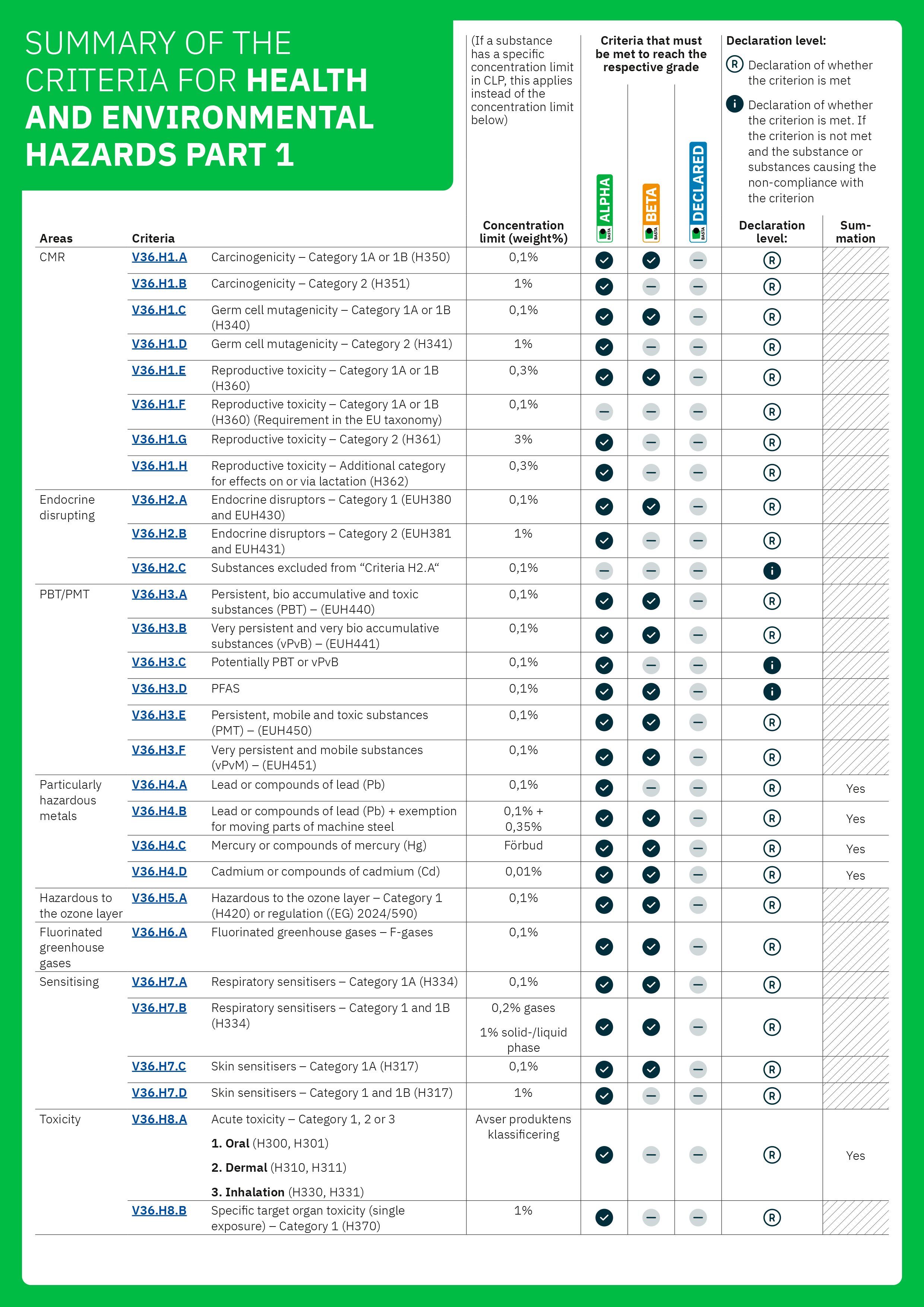
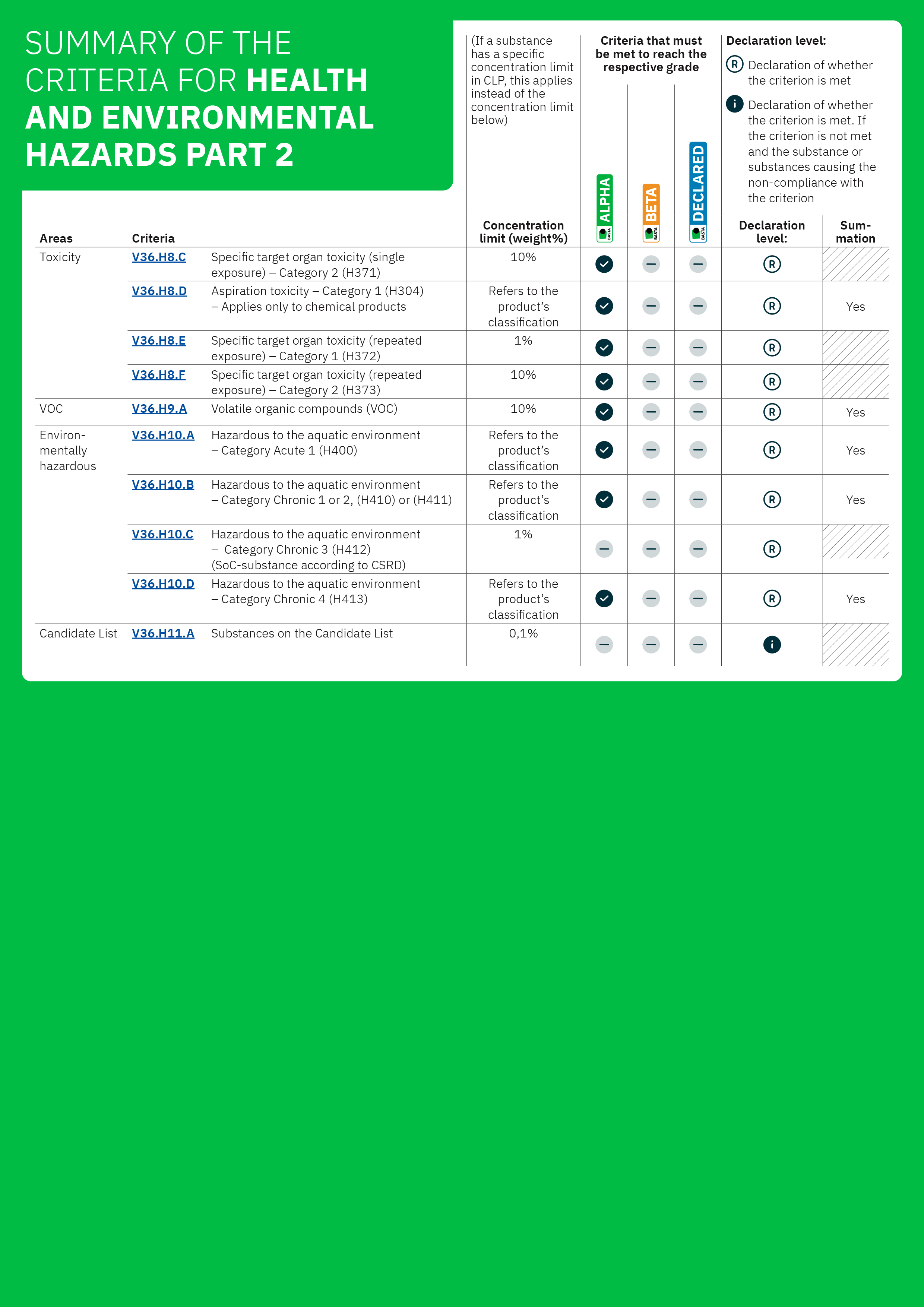
This criteria area is the basis of the BASTA system and limits substances with different health and environmentally hazardous properties. The criteria area comprises 39 criteria which are divided into 11 areas.
When registering a product in the BASTA system, it is mandatory to assess and declare which of the criteria are met and which are not. Depending on the criteria met in this criteria area, the registered product receives a specific grade.
CMR
Concentration limit (weight%)
The criterion must be fulfilled to achieve grade
Declaration level
Concentration limit (weight%)
The criterion must be fulfilled to achieve grade
Declaration level
Concentration limit (weight%)
The criterion must be fulfilled to achieve grade
Declaration level
Concentration limit (weight%)
The criterion must be fulfilled to achieve grade
Declaration level
Concentration limit (weight%)
The criterion must be fulfilled to achieve grade
Declaration level
Concentration limit (weight%)
The criterion must be fulfilled to achieve grade
Declaration level
Concentration limit (weight%)
The criterion must be fulfilled to achieve grade
Declaration level
Concentration limit (weight%)
The criterion must be fulfilled to achieve grade
Declaration level
Endocrine disrupting
Concentration limit (weight%)
The criterion must be fulfilled to achieve grade
Declaration level
Concentration limit (weight%)
The criterion must be fulfilled to achieve grade
Declaration level
Concentration limit (weight%)
The criterion must be fulfilled to achieve grade
Declaration level
PBT/PMT
Concentration limit (weight%)
The criterion must be fulfilled to achieve grade
Declaration level
Concentration limit (weight%)
The criterion must be fulfilled to achieve grade
Declaration level
Concentration limit (weight%)
The criterion must be fulfilled to achieve grade
Declaration level
Concentration limit (weight%)
The criterion must be fulfilled to achieve grade
Declaration level
Concentration limit (weight%)
The criterion must be fulfilled to achieve grade
Declaration level
Concentration limit (weight%)
The criterion must be fulfilled to achieve grade
Declaration level
Particularly hazardous metals
Concentration limit (weight%)
The criterion must be fulfilled to achieve grade
Declaration level
Concentration limit (weight%)
The criterion must be fulfilled to achieve grade
Declaration level
Concentration limit (weight%)
The criterion must be fulfilled to achieve grade
Declaration level
Concentration limit (weight%)
The criterion must be fulfilled to achieve grade
Declaration level
Hazardous to the ozone layer
Concentration limit (weight%)
The criterion must be fulfilled to achieve grade
Declaration level
Fluorinated greenhouse gases
Concentration limit (weight%)
The criterion must be fulfilled to achieve grade
Declaration level
Sensitising
Concentration limit (weight%)
The criterion must be fulfilled to achieve grade
Declaration level
Concentration limit (weight%)
The criterion must be fulfilled to achieve grade
Declaration level
Concentration limit (weight%)
The criterion must be fulfilled to achieve grade
Declaration level
Concentration limit (weight%)
The criterion must be fulfilled to achieve grade
Declaration level
Toxicity
Categories:
- Oral (H300, H301)
- Dermal (H310, H311)
- Inhalation (H330, H331)
Concentration limit (weight%)
The criterion must be fulfilled to achieve grade
Declaration level
Concentration limit (weight%)
The criterion must be fulfilled to achieve grade
Declaration level
Concentration limit (weight%)
The criterion must be fulfilled to achieve grade
Declaration level
Concentration limit (weight%)
The criterion must be fulfilled to achieve grade
Declaration level
Concentration limit (weight%)
The criterion must be fulfilled to achieve grade
Declaration level
Concentration limit (weight%)
The criterion must be fulfilled to achieve grade
Declaration level
VOC
Concentration limit (weight%)
The criterion must be fulfilled to achieve grade
Declaration level
Environmentally hazardous
Concentration limit (weight%)
The criterion must be fulfilled to achieve grade
Declaration level
Concentration limit (weight%)
The criterion must be fulfilled to achieve grade
Declaration level
Concentration limit (weight%)
The criterion must be fulfilled to achieve grade
Declaration level
Concentration limit (weight%)
The criterion must be fulfilled to achieve grade
Declaration level
Candidate List
Concentration limit (weight%)
The criterion must be fulfilled to achieve grade
Declaration level
Grades in the BASTA system
Based on which criteria are fulfilled, one of the following grades is obtained





Read more about our grades here.
Circularity
To achieve more circular flows, it is important to both use recycled materials in new products and that products that are manufactured can be recycled in the future. Information on circularity can be provided under this criteria area.
If the product contains circulated material as defined below, the following information may be declared upon registration:
- Share of circulated material expressed as % of total weight of product
- Share of circulated material that is:
- Reused material/raw material – in %
- Recycled material/raw material – in %
(100% of specified "Circulated material" shall be distributed among these items)
- Share of recycled material/raw material originating from:
- Pre-consumer – in %
- Post-consumer – in %
(100% of specified "Recycled material/raw material" shall be distributed among these items)
- Indicate which material(s) are recycled. If there are several different types of material, also indicate the percentage of each recycled material.
Definitions:
- Circulated material: Material circulated by reuse or recycling
- Reuse: A non-waste product or component is used again to fulfil the same function for which it was originally intended. As defined in the Environmental Code, 1998:808 with amendment SFS:2020:601
- Recycled materials: Material from a product or component taken from the waste stream and returned to the production process. Intermediate steps such as collection, handling, purification and more may occur. As defined in ISO 14021:2017
- Pre-consumer recycled: The recycling step has taken place before the consumer stage, such as the collection and return of waste streams from production waste. Please note that the collection and re-introduction of residual material and waste that arises within the same production process shall not be included
Post-consumer recycled: The recycling step has taken place after the consumer stage, for example through collection/return after a product has been used by the consumer
If the product can be reused as defined below, the following information may be declared upon registration:
- Share (weight-%) that can be reused
If the product is prepared to be material recycled as defined below, the following information may be declared upon registration:
- Share (weight-%) that can be material recycled
If the company has a circular business model for the product, the following information may be declared upon registration (one or more of the options below can be selected upon registration):
a) The product can be disassembled, reassembled
b) A circular business model, or similar, exists for the product
c) Other way to support a circularity for the product exists.
Renewability

This criteria area contains criteria that deal with the product's renewability, such as the percentage of renewable content.
If the product contains renewable raw materials/materials as defined below, the following information may be declared upon registration:
- Share (weight-%) of the product that comes from renewable materials/raw materials
Environmental effects - EPD

Under this criteria area, it is possible to enter information from EPDs, Environmental Product Declarations. This data shows information about the article's environmental performance from a life cycle perspective.
If a verified/third-party audited EPD (Environmental Product Declaration) (or similar, see the National Board of Housing, Building and Planning i.e. Boverket) exist in accordance with ISO 14025 and EN 15804 for the product and if this information is to be reported, the following information (Mandatory) must be provided upon registration:
- State whether the EPD complies with the standard EN 15804+A1 or EN 15804+A2 (If both are available, EN 15804+A2 should be used)
- State whether the EPD is product-specific or a sector EPD (generic)
- EPD registration number
- Last validity date of the EPD
- Link to published and verified EPD at the programme operator’s website
- Functional/Declared unit in the EPD (i.e. the unit to which the climate impact is related in the EPD). (e.g. kg, tonne, m3, m2, pcs)
- The weight in kg per functional/declared unit stated in the EPD, excluding packaging (i.e. what does the declared unit mentioned in point 6 weigh (e.g. kg, tonne, m3, m2, pcs))
(The purpose of points 6 and 7 above is to get the environmental impact per 1 CO2e/ kg of product)
- Weight of the registered item, including packaging. This is the same criterion as V36.AI7
- Weight of the registered item, excluding packaging. This is the same criterion as V36.AI8
If a daughter EPD is produced with an approved EPD tool in accordance with ISO 14025 and EN 15804, the following information must also be provided (Mandatory) when registering:
10. Registration number of the mother EPD
11. Programme operator for the mother EPD
Generic climate data (optional, can also be provided independently of the above data)
12. Resource ID of a comparable generic product in the National Board of Housing, Building and Planning's generic climate data base. This is used to link the article to the National Board of Housing, Building and Planning's climate database and be able to show generic climate data (should only be done if there is a comparable product in the National Board of Housing, Building and Planning's database).
For the following indicators, information can be provided at registration. Information is provided per functional/declared unit. The indicators that can be provided depend on whether the EPD complies with the standard EN 15804+A1 or EN 15804+A2.
|
Indicator |
Explanation |
Life cycle phase |
Possible to submit for EPDs according to: |
|
GWP-total |
Global warming potential from fossil fuels, biogenic sources, land use and land use change |
A1–A3, A4, A5 and C1-C4 |
EN 15804+A1 & EN 15804+A2 |
|
GWP-fossil |
Global warming potential, fossil fuels |
A1–A3, A4, A5 and C1-C4 |
EN 15804+A2 |
|
GWP-biogenic |
Global warming potential, biogenic |
A1–A3, A4, A5 and C1-C4 |
EN 15804+A2 |
|
GWP-luluc |
Global warming potential, land use and land use change |
A1–A3, A4, A5 and C1-C4 |
EN 15804+A2 |
|
GWP-GHG |
Climate impact converted to "Global warming potential - Greenhouse gas". This is the climate impact excluding the uptake and emission of biogenic carbon. Same as GWP100 and GWP-IOBC |
A1–A3, A4, A5 and C1-C4 |
EN 15804+A1 & EN 15804+A2 |
|
ODP |
Depletion potential of the stratospheric ozone layer |
A1-A3 and A4 |
EN 15804+A2 |
|
AP |
Acidification potential |
A1-A3 and A4 |
EN 15804+A2 |
|
EP-fw |
Eutrophication potential, freshwater |
A1-A3 and A4 |
EN 15804+A2 |
|
EP-m |
Eutrophication potential, marine |
A1-A3 and A4 |
EN 15804+A2 |
|
EP-t |
Eutrophication potential, terrestrial |
A1-A3 and A4 |
EN 15804+A2 |
|
POCP |
Formation potential of tropospheric ozone |
A1-A3 and A4 |
EN 15804+A2 |
|
ADP-mm |
Abiotic depletion potential for non-fossil resources |
A1-A3 and A4 |
EN 15804+A2 |
|
ADP-f |
Abiotic depletion potential for fossil resources |
A1-A3 and A4 |
EN 15804+A2 |
|
Indicator |
Explanation |
Possible to submit for EPDs according to: |
|
Biogenic carbon content in product |
Embodied biogenic carbon in product at the factory gate in kg/declared unit |
EN 15804+A2 |
|
Biogenic carbon content in packaging |
Embodied biogenic carbon content in packaging at the factory gate in kg/declared unit |
EN 15804+A2 |
For EPDs according to EN 15804+A1:
When registering, the following GWP indicators are mandatory:
- GWP-total
- GWP-GHG
GWP-GHG is calculated by excluding the reported biogenic carbon dioxide in the EPD from GWP-total. If this information is not available, the EPD cannot be used for use in a climate declaration according to the Climate Declaration Act.
Boverket (2024). Climate data for the calculation. www.boverket.se/sv/klimatdeklaration/gor-sa-har/underlag/klimatdata-till-berakningen/ Retrieved 2024-12-10.
Mandatory LCA modules for specified GWP indicators are:
- A1–A3
Emissions and tests

This criteria area enables results from tests on emissions etc. can be submitted in a structured manner.
The following information related to volatile organic compound (VOC) emission testing can be provided:
E1.1 Obtained certificate (for instance EMICODE EC1plus/EC1/EC2, Blue Angel, M1/M2 (RTS), GUT, AgBB)
E1.2 Measurement method/standard (for instance ISO 16000–9, ISO 16000–10, ISO 16000–6, ISO 16000–3, EN 16516, EN 717–1, CDPH Standard Method v1.1)
E1.3 Measured content expressed in unit [μg/m3]
E1.4 If the article is exempted from emission measurement due to the fact that it does not contain any organic material
The following information related to formaldehyde emission testing can be provided:
E2.1 Measurement method/standard (for instance ISO 16000–9, ISO 16000–10, ISO 16000-6, ISO 16000-3, EN 16516, EN 717-1, CDPH Standard Method v1.1)
E2.2 Measured content expressed in unit [mg/m3]
E2.3 If the article is exempted from emission measurement due to the fact that it does not contain any organic material
E2.4 If the article is exempted from emission measurement due to the fact that it does not contain any organic material. If the measurement method indicated under point 1 an approved measurement method according to the DNSH criteria for the environmental objective “Pollution prevention and control” in the EU taxonomy 2020/852/EU
E2.5 If the article falls within the product types that according to the DNSH criteria for the environmental objective "Pollution prevention and control" in the EU taxonomy must fulfil emission requirements
The following information related to emission testing for carcinogenic volatile organic compounds of categories 1A and 1B can be provided:
E3.1 Measurement method/standard (for instance ISO 16000–9, ISO 16000-10, ISO 16000-6, ISO 16000-3, EN 16516, EN 717-1, CDPH Standard Method v1.1)
E3.2 Measured content expressed in unit [mg/m3]
E3.3 If the article is exempted from emission measurement due to the fact that it does not contain any organic material
E3.4 If the measurement method indicated under point 1 an approved measurement method according to the DNSH criteria for the environmental objective "Pollution prevention and control" in the EU taxonomy 2020/852/EU
E3.5 If the article falls within the product types that according to the DNSH criteria for the environmental objective "Pollution prevention and control" in the EU taxonomy must fulfil emission requirements
For products tested according to "4MS – Leaching of lead into drinking water ", the following should be declared upon registration:
- The product is approved according to 4MS – Leaching of lead into drinking water is less than 5 μg/l.
- Information on the lead content of the copper alloy in the following ranges:
· The 4MS approved copper alloy contains ≤ 0,25% Lead
· The 4MS approved copper alloy contains >0,25–0,8% Lead
· The 4MS approved copper alloy contains >0,8% Lead
- Results from the 4MS report expressed in unit [μg/l]
For more information: Approval and Harmonization – 4MS Initiative | Umweltbundesamt.