
EU Taxonomy
The EU taxonomy regulation is a classification system for environmentally sustainable activities within the EU. The purpose of the regulation is, among other things, to introduce common definitions of what is sustainable, and thus make it easier for investors to make sustainable investments. An investment is defined as sustainable if it significantly contributes to one of the six environmental goals established in the taxonomy, while it does not contribute negatively to any of the other goals, and fulfills fundamental rights in social sustainability.
The developed framework affects a number of economic activities within the EU, among other things there are criteria for activities in the construction and maintenance of buildings that set requirements for the building materials to be used. Criteria for building materials and building elements are described in technical review criteria. For building materials the so-called Do no significant harm (DNSH) criteria in Appendix C within the taxonomy are central and decisively influence the work done in the various assessment systems.
In the taxonomy there are requirements for chemical content (described in Appendix C) and for products used indoors there are emission requirements.
In the BASTA system, we show whether a product meets these criteria, for checking against Appendix C, checking is done against BASTA's mandatory criteria. For checking of emission requirements, information needs to be provided under the emission criteria.

Information
Read more about the Taxonomy and the requirements here: Förordning - 2020/852 - EN - Taxonomiförordningen - EUR-Lex
How does it look on a product?
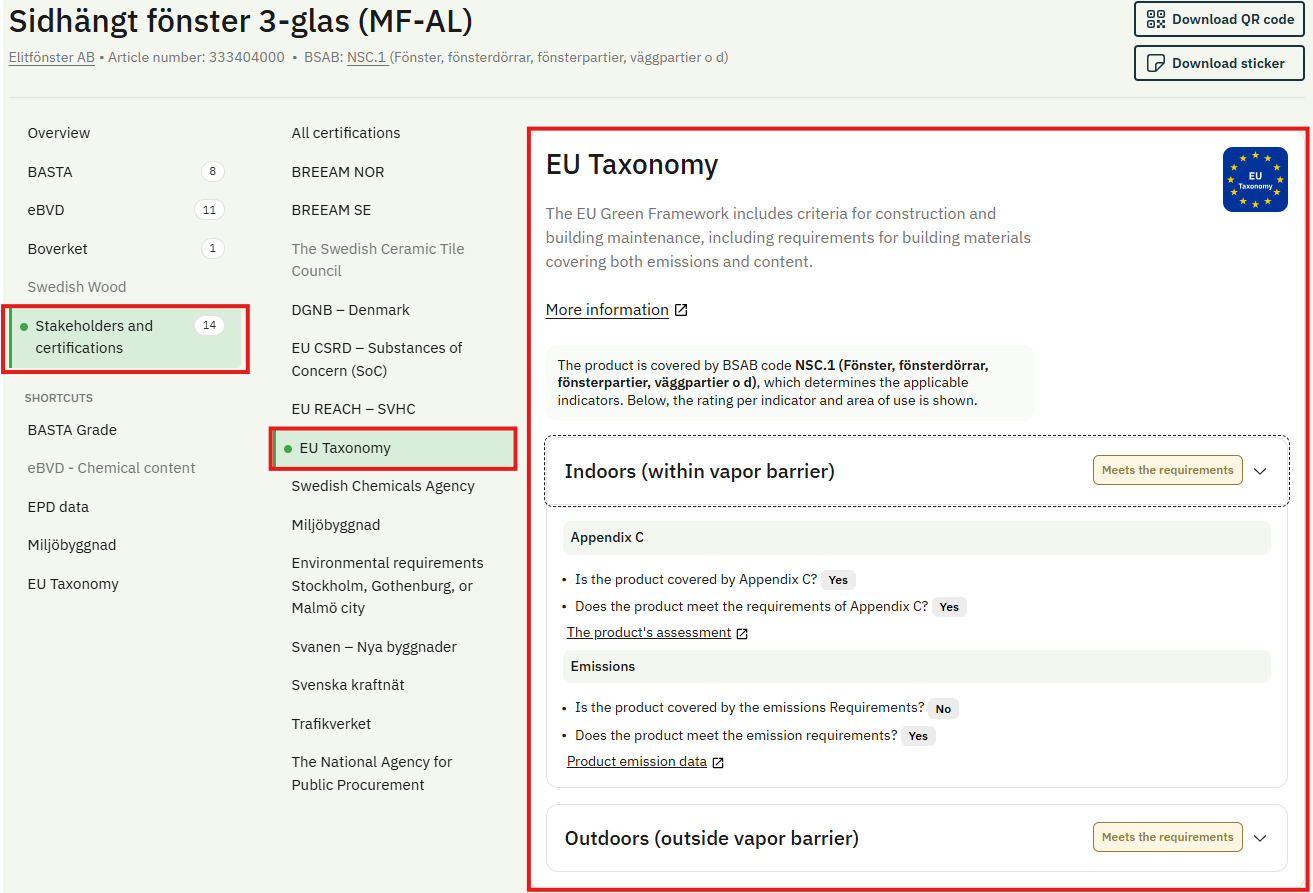
Criteria
In DNSH - Reference to Appendix C and emission requirements
Criteria
Building components and materials used in the construction that may come into contact with occupiers(89) emit less than 0,06 mg of formaldehyde per m3 of test chamber air upon testing in accordance with the conditions specified in Annex XVII to Regulation (EC) No 1907/2006 and less than 0,001 mg of other categories 1A and 1B carcinogenic volatile organic compounds per m3 of test chamber air, upon testing in accordance with CEN/EN 16516(90) or ISO 16000-3:2011(91) or other equivalent standardised test conditions and determination methods(92).
(89) Applying to paints and varnishes, ceiling tiles, floor coverings, including associated adhesives and sealants, internal insulation and interior surface treatments, such as to treat damp and mould.
(90) CEN/TS 16516: 2013, Construction products – Assessment of release of dangerous substances –Determination of emissions into indoor air.
(91) ISO 16000-3:2011, Indoor air — Part 3: Determination of formaldehyde and other carbonyl compounds in indoor air and test chamber air — Active sampling method.
(92) The emissions thresholds for carcinogenic volatile organic compounds relate to a 28-day test period.
What needs to be checked
- Testing for formaldehyde can be done with equivalent test methods to Annex XVII. ISO 16516 is assessed as an equivalent test method
- Testing must be carried out on the product types specified in footnote (89). This means that the following product types, "paints and varnishes, ceiling tiles, floor coverings, including associated adhesives and sealants, internal insulation and interior surface treatments, such as to treat damp and mould", must meet the emission requirements
- Products that do not contain organic materials do not need to be emissions tested
- Testning för formaldehyd kan göras med likvärdiga testmetoder till Annex XVII. ISO 16516 bedöms som en likvärdig testmetod
Testning ska genomföras på de produkttyper som finns specificerade i fotnoten (89). Det betyder att följande produkttyper, “paints and varnishes, ceiling tiles, floor coverings, including associated adhesives and sealants, internal insulation and interior surface treatments, such as to treat damp and mould”, ska uppfylla emissionskraven - Products that do not contain organic materials do not need to be emission tested.
Which products are covered?
According to the industry agreement described above, the following products are covered by the emission requirements.
Regarding emissions, it is recommended that the emission requirements for the following BSAB codes below be checked. The starting point for the selection of product groups has been the footnote stated in connection with the emission requirement and the clarification that has been made about the taxonomy.
The BSAB codes KB, KE and KY are included because they are often a source of formaldehyde emissions and the clarification about the taxonomy that was published on 2024-11-29. The codes listed below primarily cover the products that are explicitly mentioned in these documents, but also products that are used in similar contexts and are therefore considered relevant to include. The aim is to apply the requirements consistently and in line with the taxonomy's goal - to protect building users from harmful emissions.
BSAB-codes (in Swedish)
- IB - Termisk isolering m m i hus (ej platsbyggt kyl- eller frysrum)
- KB - Skikt av cement- eller gipsbaserade skivor
- KE - Skikt av skivor av trä eller träbaserat material
- KY - Skikt av skivor av diverse material
- LC - Målning m m
- LD – Skyddsbeläggning
- LF – Skyddsimpregnering
- MB - Beläggningar och beklädnader av fogplattor av natursten, betong, konstbetong, keramik, mosaik e d
- MC - Beläggningar av trä (Har ersatt tidigare MD)
- ME - Beläggningar av laminatgolv
- MF - Beläggningar av textil, kork, linoleum, gummi, plast m m och tätskikt av plastmatta
- MH- Beläggningar av massa m m
- MJ - Beklädnader av textil, kork, linoleum, gummi, plast e d och tätskikt av plastmatta
- NSF - Undertak av förtillverkade komponenter
- ZSB - Tätning av fogar i hus
The following construction products are not covered by the emission requirements:
- Construction products that are not permanently built into the building, such as furniture, fabrics and white goods
- Construction products outside the building; in or on the ground
- Construction products used outdoors (outside the vapor barrier)
- Construction products that are only used during construction
- Construction products that are used in small quantities, such as plastic strips, moldings, lining or similar
- Consumables such as ground spray, fuel, etc.
Touch-up paints for products damaged during assembly/installation - Untreated wood products
- Products that only contain inorganic compounds do not need to be emission tested and always meet the emission requirements
The above recommendation gives us the opportunity to work with the taxonomy requirements until we have received a firm decision on which product groups should be covered
Kriterier som måste uppfyllas i BASTA-systemet
För att kunna uppfylla emissionskraven finns möjlighet att lämna följande information om formaldehyd (Kriterium E2: Formaldehyd) och carcinogena flyktiga organiska ämnen (Kriterium E3: Carcinogena flyktiga organiska föreningar).
Information that may be provided:
In order to meet the emission requirements, it is possible to provide the following information about formaldehyde (Criterion E2: Formaldehyde) and carcinogenic volatile organic substances (Criterion E3: Carcinogenic volatile organic compounds).
- Measurement method/standard
- Measured concentration
- If the article is exempt from emission measurement due to the fact that it does not contain any organic material
- If the measurement method specified under point 1 an approved measurement method according to the DNSH criteria for the environmental objective "Prevention and control of pollution" in the EU taxonomy 2020/852/EU
- If the article is covered by the product types that, according to the DNSH criteria for the environmental objective "Prevention and control of pollution" must meet emission requirements in the EU taxonomy
What is required to fulfill the requirements of the taxonomy:
To be approved for the emission requirements, the product must meet one of the following scenarios (for both criteria E2 & E3):
- Exempted from emission measurement due to the fact that it does not contain any organic material (Point 3 above)
- Not covered by the product types covered by the taxonomy's emission requirements (Point 5 above)
- Have an emission value below the limit value according to the taxonomy (Point 2 above), have a specified measurement method/standard (Point 1 above) and have confirmed that the specified measurement method is approved according to the taxonomy (Point 4 above)
Criteria
GENERIC CRITERIA FOR DNSH TO POLLUTION PREVENTION AND CONTROL REGARDING USE AND PRESENCE OF CHEMICALS
The activity does not lead to the manufacture, placing on the market or use of:
a) substances, whether on their own, in mixtures or in articles, listed in Annexes I or II to Regulation (EU) 2019/1021, except in the case of substances present as an unintentional trace contaminant;
b) mercury and mercury compounds, their mixtures and mercury-added products as defined in Article 2 of Regulation (EU) 2017/852 ;
c) substances, whether on their own, in mixture or in articles, listed in Annexes I or II to Regulation (EC) No 1005/2009;
d) substances, whether on their own, in mixtures or in an articles, listed in Annex II to Directive 2011/65/EU, except where there is full compliance with Article 4(1) of that Directive;
e) substances, whether on their own, in mixtures or in an article, listed in Annex XVII to Regulation (EC) 1907/2006, except where there is full compliance with the conditions specified in that Annex;
f) substances, whether on their own, or in mixtures or in an article, in a concentration above 0,1 % weight by weight (w/w), and meeting the criteria laid down in Article 57 of Regulation (EC) 1907/2006 and that were identified in accordance with Article 59(1) of that Regulation for a period of at least 18 months, except if it is assessed and documented by the operators that no other suitable alternative substances or technologies are available on the market, and that they are used under controlled conditions*1
*1 The Commission will review the exceptions from the prohibition from manufacturing, placing on the market or use of the substances referred to in point (f) once it will have published horizontal principles on essential use of chemicals
What needs to be checked
Point a)-e)
No extra control of these points is needed (however, the assessment systems have criteria that still capture the majority of these criteria)
Point f)
Point f) must be checked as it goes beyond the legislation. Substances on the candidate list must not be present in concentrations above 0.1% by weight
Recommendation on what is covered
In order to proceed with the information we have and make the work manageable, the assessment companies (BASTA, Byggvarubedömningen, SundaHus) have developed a recommendation and selected the following BSAB codes for Appendix C to be checked, see table below (information on emissions is further down). The starting point for the selection of product groups has been the clarification that has come about the taxonomy and the product groups specified in the certification systems. This is only a recommendation and we urge everyone to check this recommendation with their auditor.
BSAB – Appendix C (Codes in swedish)
- E - platsgjutna konstruktioner
- F - murverk
- G - konstruktioner av monteringsfärdiga element
- H - konstruktioner av längdformvaror
- I - skikt av termoisolervaror m m i hus och i grundkonstruktioner till hus
- J - skikt av byggpapp, tätskiktsmatta, asfalt, duk, plastfilm, plan plåt, överläggsplattor e d
- K - skikt av skivor
- L - puts, målning, skyddsbeläggningar, skyddsimpregneringar m m
- M - skikt av beläggnings- och beklädnadsvaror i hus
- N - kompletteringar av sakvaror m m
- Z - diverse tätningar, kompletteringar, infästningar o d
- PN - rörledningar m m
- PQ - rökkanaler och avgaskanaler
- PR - brunnar, spygatter, golvrännor m m
- PT - rumsmonterade värmare och kylare
- QK – ljuddämpare
- QL - ventilationskanaler m m
- QM - luftdon m m
- R - isolering av installationer
- SBF – Kanalsystem
- SBQ - kanalinstallation av elinstallation, flexrör e d
- SC - el- och telekablar m m
The following construction products are not covered by Appendix C:
-
Construction products that are not permanently built into the building, such as furniture, fabrics and white goods
-
Construction products outside the building; in or on the ground
-
Construction products that are only used during construction
-
Construction products that are used in small quantities, such as screws, nails, nuts, sheet metal strips, perforated strips, plastic strips or similar
-
Consumable products such as ground spray, fuel, etc.
The above recommendation gives us the opportunity to work with the taxonomy's requirements until we have received a firm decision on which product groups should be covered.
What is required in the BASTA system
Appendix C
Point a)-e)
No extra checking of these points is needed
Point f)
That BASTA's criterion H11.A is met
How the industry is working with the taxonomy?
In the fall of 2022, the assessment companies started a collaborative group that grew to include actors from the entire industry. Today, the group is part of Byggföretagen's anda Fastighetsägarnas taxonomy network. The following organizations are included:
- Assessment companies - BASTA, Byggvarubedomningen & SundaHus
- Certification body - The Nordic Swan, SGBC
- Construction companies - Byggföretagen, Fabege, NCC, PEAB, Serneke, Skanska, Sweden's public utility, Veidekke, etc.
- Material manufacturers - Byggmaterialindustriern/KTF, VVS Fabrikarterna
- Fastighetsägarna
The goal of the collaboration is to find a common approach to the taxonomy with a focus on hazardous substances in building materials. We want to make sure of a solution that works on the Swedish market and that gives both manufacturers/suppliers and the person who is going to buy a product reliable, and verifiable, information. The network has closely followed the evolution of the taxonomy through published clarifications and the most recently published addendum to the delegated act and the remaining environmental targets
In addition, BASTA leads a group within Byggföretagen and Fastighetsägarna that focuses on the taxonomy's material requirements.
Status today
In this group, a working method has been worked out, which has been presented and accepted in the Taxonomy Network of Byggföretagen and Fastighetsägarna.
This proposal is now published on this page: Click here.
Update February 2026
Update February 2026
In January 2026, an update to the taxonomy was released, which meant that what was added to Appendix C in January 2025 was withdrawn.
In connection with this, the industry-wide interpretation document was updated with both the updated requirements and the industry-wide recommendation that was developed in 2025. So now everything is in one place.
We urge everyone to check the requirement levels and how these are met with their auditor.
Remaining questions
Pending the final clarifications, the agreed working method described below is now being applied. When clarifications are published, the way of working may need to change.
The Commission continuously has a "stakeholder request mechanism" where stakeholders can provide input on the taxonomy criteria.
Questions and comments as described above have been submitted and clarifications and proposed amendments have been provided by the EU. The working group is working to get all the necessary interpretations in place.