What is CSRD and sustainability reporting?

Sustainability has become an increasingly important issue. Society now expects companies not only to report on their financial performance, but also to disclose how their operations impact the environment, people, and society.
CSRD is an amending directive that has been implemented in Sweden through changes to, among other legislation, the Annual Accounts Act. The legislative changes concerning corporate sustainability reporting entered into force on 1 July 2024.
The development is particularly significant for the construction and real estate sectors. The construction industry accounts for a substantial share of society’s climate impact, resource consumption, and waste generation. At the same time, large volumes of materials and chemical products are used in buildings and infrastructure projects. As a result, reporting on climate impact, resource use, circularity, and chemical content will become a key requirement for companies throughout the construction value chain.
What Is CSRD?
The Corporate Sustainability Reporting Directive (CSRD) is the European Union’s sustainability reporting directive, designed to establish a common framework for how companies disclose sustainability-related information. The objective is to enable investors, customers, authorities, and other stakeholders to compare companies more consistently and transparently. The directive is also intended to help direct capital and investments towards more sustainable business activities.
One of the most significant changes compared with previous regulations is that sustainability information must now be reported with the same level of rigor as financial information. Sustainability disclosures must be included in the annual report, and the reported information must be subject to external assurance. This increases the requirements for the quality, traceability, and reliability of the data companies provide.
CSRD also expands the number of companies subject to reporting requirements. Even businesses that are not directly covered by the directive may be affected indirectly, as larger companies will need to collect information from suppliers and subcontractors in order to report on their entire value chain. This is particularly relevant in the construction industry, where long and complex supply chains are common.
ESRS
While CSRD establishes the requirement for companies to report sustainability information, the European Sustainability Reporting Standards (ESRS) define what information must be disclosed and how reporting should be carried out. ESRS covers the three main ESG areas (Environmental, Social and Governance):
- Environmental: Climate change, pollution, water and marine resources, biodiversity, and the circular economy.
- Social: Working conditions, occupational health and safety, human rights, affected communities, and the interests of consumers and end-users.
- Governance: Business conduct, anti-corruption measures, risk management, management accountability, and internal control.
Double materiality: a core principle
One of the most important innovations introduced by CSRD is the requirement for a double materiality assessment. Companies must evaluate sustainability issues from two perspectives:
- How the company's activities impact people and the environment.
- How sustainability-related risks and opportunities affect the company’s financial performance and value creation.
For example, a construction company must report both how its operations contribute to greenhouse gas emissions and how future climate regulations, increasing energy costs, or changing customer expectations could affect its business model and financial performance. The double materiality assessment forms the foundation of sustainability reporting and helps companies identify the issues that are most relevant to monitor and disclose.
How does CSRD affect the construction industry?
Climate impact
Companies are required to disclose their greenhouse gas emissions and explain how they are working to reduce their climate impact. For construction companies and manufacturers of building products, this means that climate data relating to materials, transportation, energy use, and production processes will become increasingly important.
Circular economy
CSRD and ESRS include requirements related to resource efficiency and the circular economy. Within the construction sector, this includes areas such as recycling, reuse, material efficiency, and the ability to dismantle building products for future recovery and reuse.
Chemicals and pollution
The environmental standard ESRS E2 addresses pollution and chemicals. It includes reporting requirements related to Substances of Concern (SoC) and Substances of Very High Concern (SVHC). These substances are particularly relevant for construction products because they may impact both human health and the environment.
Examples of substance groups receiving particular attention include:
- SVHC substances under REACH.
- CMR substances (carcinogenic, mutagenic, and reprotoxic substances).
- Substances classified as hazardous to the environment.
- Substances with harmonised classifications under the CLP Regulation.
This development means that companies increasingly need detailed knowledge of the substances contained in their products. As a result, product documentation will become more important as a source of information for sustainability reporting.
The importance of product data
Because CSRD requires information from across the entire value chain, demand for high-quality and digitally accessible product data will increase. Product manufacturers must be able to provide information that enables their customers to report in accordance with ESRS requirements.
Examples of commonly requested information include:
- Chemical content
- Climate data
- Resource use
- Recycled content
- Potential for reuse
- Presence of SVHC substances
This increases the importance of product information tools and systems. Within the construction sector, this includes eBVDs, Environmental Product Declarations (EPDs), BASTA registrations, and, in the future, Digital Product Passports. These systems can serve as valuable sources of information when companies collect data for their sustainability reporting.
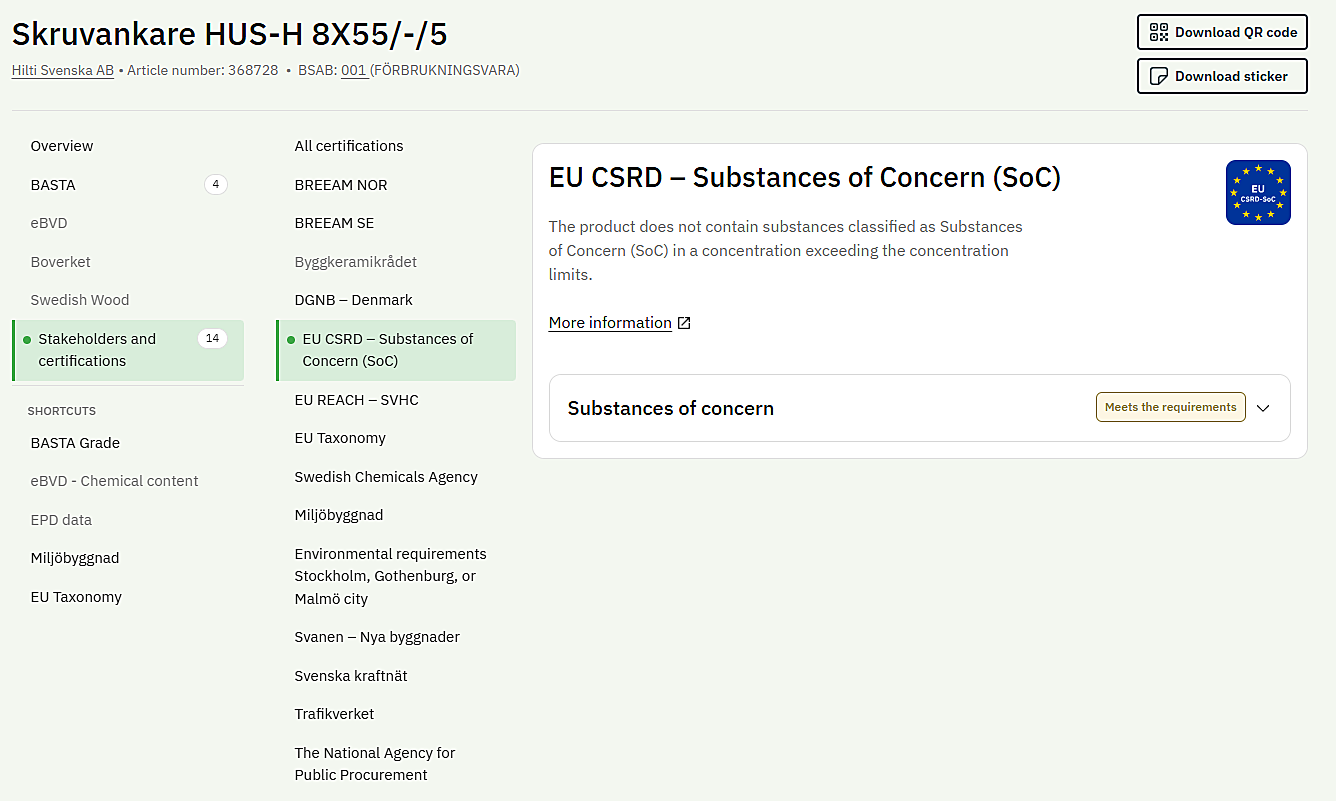
To view information about a specific product, search for it in our public search engine, BASTA Search, open the product page, and explore its data and compliance status.
For example: Hilti Svenska AB | HUS-H 8X55/-/5 Screw Anchor | Product | BASTA.