
EU Taxonomy
What is the EU Taxonomy?
The EU Taxonomy Regulation is a classification system for environmentally sustainable activities within the EU. The purpose of the regulation is, among other things, to introduce common definitions of what is sustainable and thus make it easier for investors to make sustainable investments.
Criteria for construction materials and elements are described in the technical review criteria. For construction materials, the so-called "Do no significant harm" (DNSH) criteria in Appendix C within the taxonomy are central and decisively affect the work done in the various assessment systems. The requirements concern chemical content (described in Appendix C) and for products used indoors, there are also emission requirements.
The BASTA system shows whether a product meets these two criteria:
- For control against the requirements for chemical content (DNSH criteria in Appendix C), it is the criteria under Health and environmental hazards that are checked
- In order to control emission requirements, information needs to be provided under the emission criteria.
More information
Read more about the EU Taxonomy and its criteria here: Förordning - 2020/852 - EN - Taxonomiförordningen - EUR-Lex

What does it look like on a product?
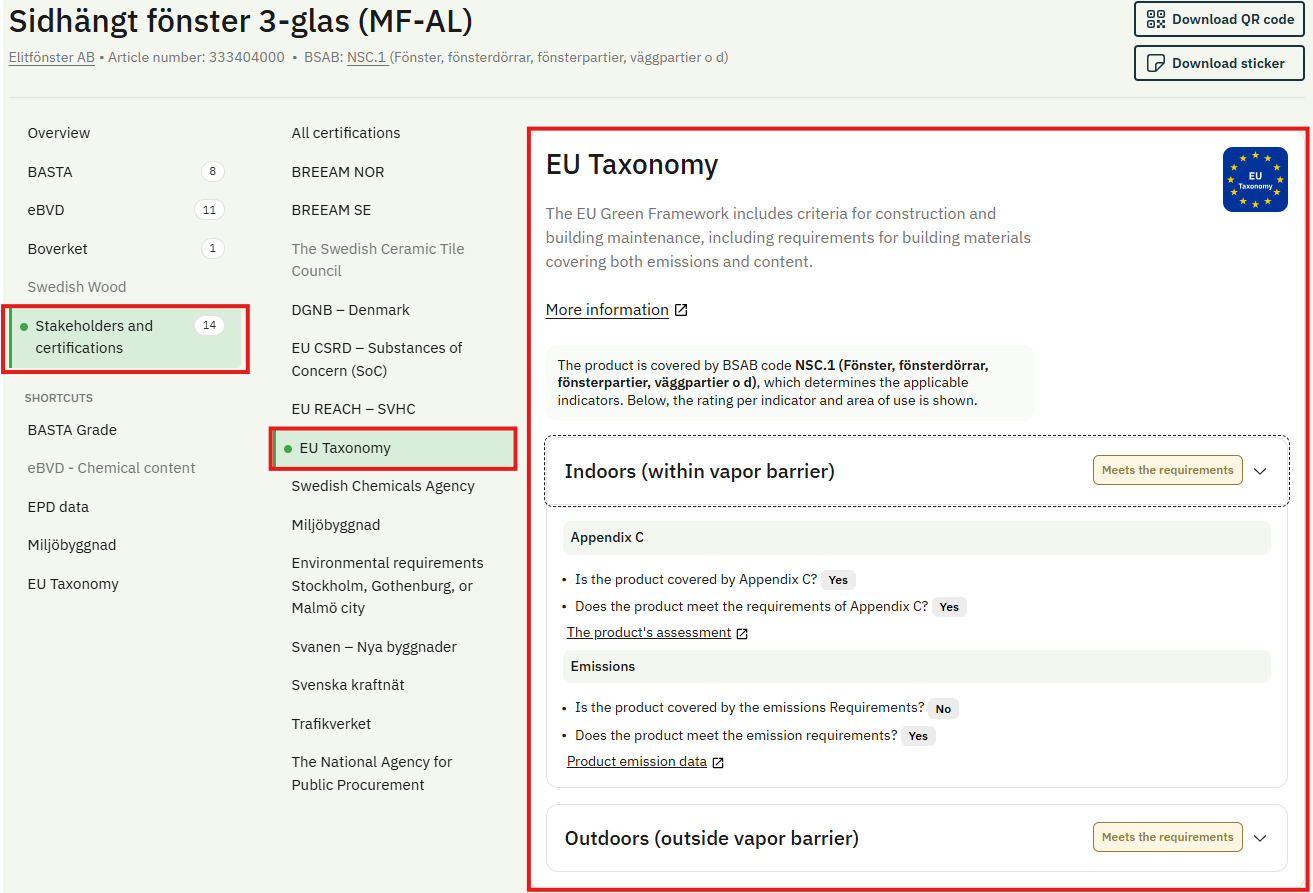
Criteria
In DNSH - Reference to Appendix C and emission requirements
Requirements:
Building components and materials used in the construction that may come into contact with occupiers(89) emit less than 0,06 mg of formaldehyde per m3 of test chamber air upon testing in accordance with the conditions specified in Annex XVII to Regulation (EC) No 1907/2006 and less than 0,001 mg of other categories 1A and 1B carcinogenic volatile organic compounds per m3 of test chamber air, upon testing in accordance with CEN/EN 16516(90) or ISO 16000-3:2011(91) or other equivalent standardised test conditions and determination methods(92).
(89) Applying to paints and varnishes, ceiling tiles, floor coverings, including associated adhesives and sealants, internal insulation and interior surface treatments, such as to treat damp and mould.
(90) CEN/TS 16516: 2013, Construction products – Assessment of release of dangerous substances –Determination of emissions into indoor air.
(91) ISO 16000-3:2011, Indoor air — Part 3: Determination of formaldehyde and other carbonyl compounds in indoor air and test chamber air — Active sampling method.
(92) The emissions thresholds for carcinogenic volatile organic compounds relate to a 28-day test period.
What needs to be checked?
- Testing for formaldehyde can be done using equivalent test methods to Annex XVII. ISO 16516 is assessed as an equivalent test method
- Testing shall be carried out on the product types specified in the footnote (89). This means that the following product types, “paints and varnishes, ceiling tiles, floor coverings, including associated adhesives and sealants, internal insulation and interior surface treatments, such as to treat damp and mould”, must meet the emission requirements
- Products that do not contain organic materials do not need to be emission tested
Which products are covered?
According to the industry agreement described above, the following products are covered by the emission requirements.
Regarding emissions, the recommendation is that the emission requirements for the following BSAB codes below are checked. The starting point for the choice of product groups has been the footnote that is stated linked to the emission requirement and the clarification that has been provided about the taxonomy.
The BSAB codes KB, KE and KY are included due to the fact that they are often a source of formaldehyde emissions and due to the clarification on the taxonomy that was published on 2024-11-29. The codes listed below mainly include the products that are explicitly mentioned in these documents, but also products that are used in similar contexts and thus deemed relevant to include. The aim is to apply the requirements consistently and in line with the taxonomy's goal – to protect the building's occupants from harmful emissions.
BSAB codes:
- IB - Thermal insulation, etc. in houses (not site-built refrigeration rooms)
- KB - Layers of cement, calcium silicate or plaster-based boards/sheets and such
- KE - Layers of boards/sheets of wood or woodbased material
- KY - Layers of boards/sheets of various materials
- LC - Painting, etc.
- LD – Protective coating
- LF – Protective impregnation
- MB - Coatings and linings of tiles of natural stone, concrete, artificial concrete, ceramics, mosaic etc.
- MC - Wood coatings/panels (Has replaced previous MD)
- ME - Coating, laminate flooring
- MF - Coatings of textile, cork, linoleum, rubber, plastic, etc. and waterproofing of plastic carpet
- MH- Coatings of pulp, etc.
- MJ - Linings, textile, cork, linoleum, rubber, plastics, etc. and waterproofing of plastic carpet
- NSF - Suspended ceilings made of prefabricated components
- ZSB - Sealing joints in houses
The following construction products are not covered by the emission requirements:
- Construction products that are not permanently built into the building, such as furniture, fabrics and appliances
- Construction products outside the building; in or on land
- Construction products used outdoors (outside the vapour barrier)
- Construction products that are only used during construction
- Construction products that are used in small quantities, such as plastic strips, moldings, linings or similar
- Consumables such as soil spray, fuel, etc.
- Touch up paints for products damaged during assembly/installation
- Untreated wood products
- Products containing only inorganic compounds do not need to be emission tested and always meet emission requirements
The above listed recommendations allows us to work with the requirements of the taxonomy until we have received a firm decision on which product groups should be covered.
Criteria that must be met in the BASTA system:
In order to meet the emission requirements, it is possible to provide the following information about formaldehyde (Criterion E2: Formaldehyde) and carcinogenic volatile organic compounds (Criterion E3: Carcinogenic volatile organic compounds).
Information that may be provided:
- Measurement method/standard
- Measured content
- If the article is exempted from emission measurement because it does not contain any organic material
- If the measurement method specified under Point 1 is an approved measurement method according to the DNSH criteria for the environmental objective ”Pollution prevention and control” of the EU taxonomy 2020/852/EU
- If the article if included in the product types that, according to the DNSH criteria for the environmental objective "Pollution prevention and control”, must meet the emission requirements of the EU taxonomy
What is required to meet the requirements of the taxonomy:
To fulfill the emission requirements, the product must meet one of the following scenarios (for both criteria E2 and E3):
-
Exempted from emission measurement because it does not contain any organic materials (Point 3 above)
-
Not covered by the product types covered by the taxonomy's emission requirements (point 5 above)
-
Have an emission value below the taxonomy limit value (Point 2 above), have a specified measurement method/standard (Point 1 above) and have confirmed that the specified measurement method is approved according to the taxonomy (Point 4 above)
Requirements:
GENERIC CRITERIA FOR DNSH TO POLLUTION PREVENTION AND CONTROL REGARDING USE AND PRESENCE OF CHEMICALS
The activity does not lead to the manufacture, placing on the market or use of:
a) substances, whether on their own, in mixtures or in articles, listed in Annexes I or II to Regulation (EU) 2019/1021, except in the case of substances present as an unintentional trace contaminant;
b) mercury and mercury compounds, their mixtures and mercury-added products as defined in Article 2 of Regulation (EU) 2017/852 ;
c) substances, whether on their own, in mixture or in articles, listed in Annexes I or II to Regulation (EC) No 1005/2009;
d) substances, whether on their own, in mixtures or in an articles, listed in Annex II to Directive 2011/65/EU, except where there is full compliance with Article 4(1) of that Directive;
e) substances, whether on their own, in mixtures or in an article, listed in Annex XVII to Regulation (EC) 1907/2006, except where there is full compliance with the conditions specified in that Annex;
f) substances, whether on their own, or in mixtures or in an article, in a concentration above 0,1 % weight by weight (w/w), and meeting the criteria laid down in Article 57 of Regulation (EC) 1907/2006 and that were identified in accordance with Article 59(1) of that Regulation for a period of at least 18 months, except if it is assessed and documented by the operators that no other suitable alternative substances or technologies are available on the market, and that they are used under controlled conditions*1
*1 The Commission will review the exceptions from the prohibition from manufacturing, placing on the market or use of the substances referred to in point (f) once it will have published horizontal principles on essential use of chemicals
What needs to be checked?
Points a)-e)
No additional control of these points is needed (however, the assessment systems have criteria that still capture the majority of these criteria).
Point f)
Point f) must be checked since it goes beyond the legislation. Substances on the Candidate List must not be present in concentrations above 0.1 weight-%.
Which products are covered?
In order to move forward with the information we have and make the work manageable, the assessment companies (BASTA, Byggvarubedömningen, SundaHus) have developed a recommendation and chosen the following BSAB codes for Appendix C to be checked, see list below (information about emissions can be found further down). The starting point for the choice of product groups has been the clarification that has come about the taxonomy and the product groups specified in the certification systems. This is only a recommendation, and we encourage everyone to check this recommendation with their auditor.
BSAB – Appendix C
- E - Site moulded constructions
- F - Masonry
- G - Constructions of prefabricated elements
- H - Constructions of longitudinal moldings
- I - Layers of thermoinsulating products, etc. in houses and foundations for houses
- J - Layers of construction cardboard, dense layer mat, asphalt, canvas, plastic film, flat plate, overlay plates etc.
- K - Layers of boards/panels
- L - Plaster, painting, protective coatings, protective impregnation, etc.
- M - Layers of coating and textile products in houses
- N - Supplementation of goods etc.
- Z - Miscellaneous seals, additions, fixings etc.
- PN - pipe network installations, etc.
- PQ - Smoke channels and exhaust ducts
- PR - Wells, spygates, floor drains, etc.
- PT - Room-mounted heaters and coolers
- QK – Muffler
- QL - Ventilation ducts, etc.
- QM - Air diffusers etc.
- R - Insulation of installations
- SBF – Duct systems
- SBQ - Duct installation of electrical installation, flex pipes, etc.
- SC - Electrical and telecommunication cables, etc.
The following construction products are not covered by Appendix C:
- Construction products that are not permanently built into the building, such as furniture, fabrics and appliances
- Construction products outside the building; in or on land
- Construction products that are only used during construction
- Construction products that are used in small quantities, such as plastic strips, moldings, linings or similar
- Consumables such as soil spray, fuel, etc.
The above listed recommendations allows us to work with the requirements of the taxonomy until we have received a firm decision on which product groups should be covered.
Criteria that must be met in the BASTA system:
Points a)-e)
No additional control of these points is needed.
Point f)
That BASTA's criterion H11.A is met.
How does the industry work?
In the autumn of 2022, the assessment companies started a collaboration group that grew to include actors from the entire industry. Today, the group is part of the Swedish Construction Federations' and the Swedish Property Federations' Taxonomy Network in Sweden. The following organizations are included:
- Assessment companies – BASTA, Byggvarubedömningen & SundaHus
- Certification bodies – Svanen, SGBC
- Construction companies – Byggföretagen (the Swedish Construction Federation), Fabege, NCC, PEAB, Serneke, Skanska, Sveriges allmännytta, Veidekke, mm
- Manufacturers – Byggmaterialindustrierna (Construction Products Sweden)/KTF, VVS Fabrikanterna
- Fastighetsägarna (the Swedish Property Federation)
The goal of the collaboration is to find a common approach to the taxonomy with a focus on hazardous substances in construction materials. We want to ensure a solution that works on the Swedish market and that provides both manufacturers/suppliers and the person who is going to purchase a product with reliable and verifiable information. The network has closely followed the development of the taxonomy through, among other things, published clarifications and additions.
BASTA also leads a group within the Swedish Construction Federation and the Swedish Property Federation that focuses on the taxonomy's material requirements.
In this group, a working method has been developed, which has been presented and accepted in the Swedish Construction Federations' and the Swedish Property Federations' taxonomy network.
This proposal is now published at Byggföretagen.
In January 2026, an update of the taxonomy was made, which meant that what was added to Appendix C in January 2025 was withdrawn. In connection with this, the industry-wide interpretative document was updated with both the updated requirements and the industry-wide recommendation that was developed in 2025. So now everything is in one place.
We encourage everyone to check the level of requirements and how these things are met with their accountant.
Pending the final clarifications, the agreed working method described above is now applied. When clarifications are published, the working method may need to be changed. The Commission has an ongoing “stakeholder request mechanism” where stakeholders can provide input on the taxonomy criteria.
Questions and comments described above have been submitted and clarifications and suggestions for changes have been provided by the EU. The working group is working to get all the necessary interpretations in place.