
DGNB – Danmark
What is DGNB - Denmark?
DGNB Denmark is the Danish version of the German Sustainable Building Council (DGNB) environmental certification system for buildings and is managed by the Danish Council for Sustainable Construction. DGNB can be used to certify both new and existing buildings, as well as urban areas.
The certification is based on points that the building achieves within the three qualities Environmental, Economy and Social Responsibility. In DGNB Renovation and New Construction, Environment is weighted with 40%, while Economy and Social Responsibility are each weighted with 30%. DGNB certification is both about striving for as high a score as possible and balancing the different qualities. Three different awards can be achieved, Planet, Heart and Diamond, within a DGNB certification.
The DGNB has links to the EU Taxonomy but they are two independent systems, where the DGNB system incorporates certain taxonomy criteria into the DGNB manual.
In the Environmental area, there is a link to the Taxonomy requirements for Appendix C (DNSH) and emissions. There is also a focus on added PFAS substances.
More information
Read more about DGNB Denmark and its criteria here: Rådet for Bæredygtigt Byggeri

What does it look like on a product?
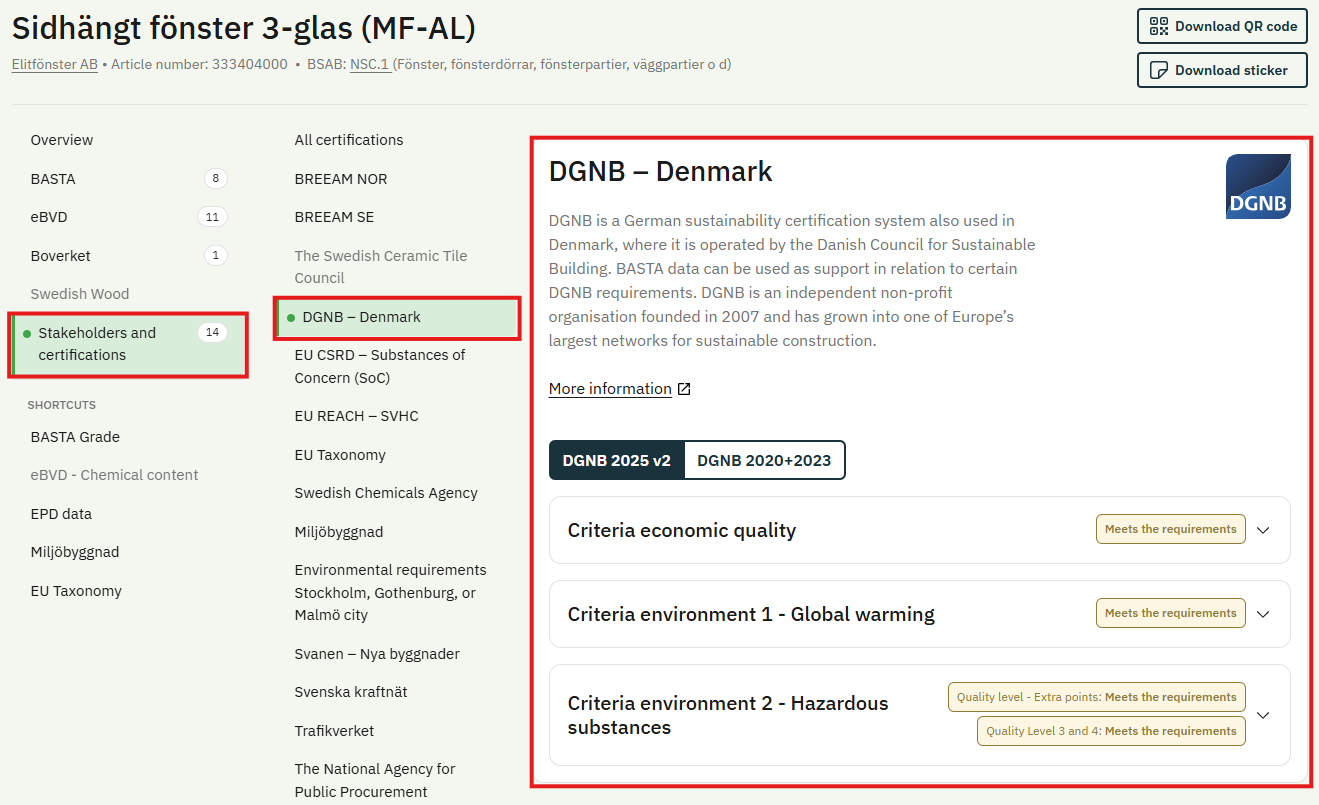
Criteria
Version 2025v2 - Manual for Renovation and New Construction
Criteria Environment 1 - Global warming
Content requirements:
That climate data (EPD) is available for the product.
Criteria Environment 2 - Hazardous substances
Content requirements:
Requirement for emission data to be available for the product.
Content requirements:
That the EU Taxonomy's requirements for content and emissions are met.
Requirements for the limitation of PFAS.
Criteria Economic Quality
Content requirements:
Requirement that the product contains circulated materials.
Version 2020+2023 - Manual for Renovation and New Construction
Criteria Environmental Quality
Content requirements:
That climate data is available for the product.
Content requirements:
Meets the DGNB's requirements for environmentally hazardous substances.
There is emission data available for the product.
Content requirements:
That the EU Taxonomy's requirements for content and emissions are met.
Requirements for the limitation of PFAS.